
What is Glenoid labrum and its role in shoulder dislocation?
The shoulder joint is a ball and socket joint made up from head of arm bone (humerus) and the shoulder socket (Glenoid). The socket or glenoid is surrounded by a ring of tissue called labrum which increases stability of the joint by deepening the socket. Following shoulder dislocation this ring of tissue (labrum) gets torn, making the shoulder unstable. An unhealed labral tear makes the shoulder prone for recurrent dislocations or subluxations (shoulder slides out partially only). 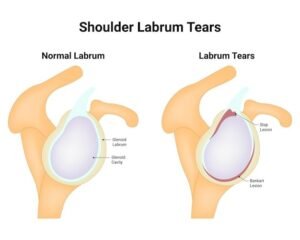
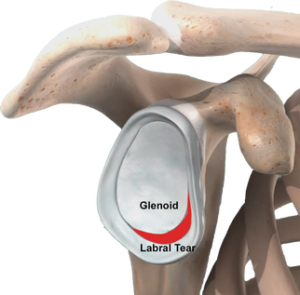
What is shoulder instability?
The main symptom of shoulder instability is that you can feel the ball of the shoulder come out of its socket or “give way” even with normal overhead activities. This is commonly associated with pain. Often, the episodes of giving way occur with specific activities or positions of the arm, such as throwing a ball, reaching an object in the overhead shelf or holding the overhead rail in train or bus.
When do I need the surgery?
Surgery is not needed for first time dislocation. Surgery is indicated if you have multiple dislocations or if you have instability symptoms. Younger your age at the time of first dislocation, the more is the likelihood of needing surgery.
What will happen if I don’t go for surgery?
The shoulder instability may start affecting your day to day activities. The shoulder can start dislocating even during sleep. The more the shoulder dislocates, the more is the cartilage damage and risk of developing arthritis in future.
Can you explain the surgical procedure in detail?
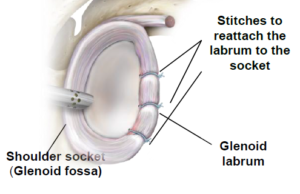
The aim of the operation is to repair the labrum around the socket and to tighten the ligaments and capsule to minimise the risk of further dislocation. It is a keyhole surgery (arthroscopy). It is done under General anaesthesia. During the operation the labrum is reattached to the socket using small “anchors” (usually biocomposite) with tails of strong suture material (stitches) that are inserted into the bone at the edge of the socket. The suture tails are used to fasten the soft tissue back into place. You will have 3-4 small (1cm) scars around the shoulder and the duration of procedure is 60min.
What are potential complications?
- Re-dislocation – Risk (5-10%)
- Stiffness
- Infection
- Nerve injuries
What are the timelines after surgery?
Hospital stay: 1-2 days
Arm immobilisation: Sling for 4 weeks
Return to driving: 6 weeks
Return to work: Desk based job – 1 to 2 weeks; Manual job – 8 to 12 weeks
Return to sports: Non-contact from 4 months; Contact/overhead from 6-8 months
Total recovery period: 3-6 months