
This page will give details about the arthroscopic rotator cuff repair surgery. To know more about Rotator cuff tears, click here
What is shoulder arthroscopy?
Arthroscopy is a minimally invasive procedure (key-hole surgery) used to view, diagnose, and treat shoulder joint problems. Through small incisions, a thin tube with a camera and surgical instruments are inserted into the shoulder joint, allowing for precise diagnosis and treatment.
What is arthroscopic rotator cuff repair?
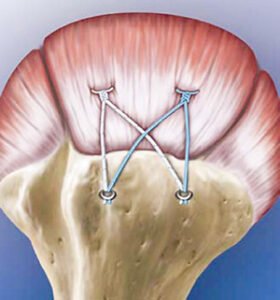
In this procedure the torn ends of the tendons are repaired back to the bone using sutures. This is done arthroscopically (key-hole) with multiple small incisions around your shoulder.
Can you explain the surgical procedure in detail?
The aim of the operation is to repair the torn tendon. This requires anaesthesia which can be either a General Anaesthesia or Regional block. The operation will involve bringing the tendon back to its original insertion on the head of the humerus. The tendon is held in place with anchors while it heals. The Anchors are small hard pellets (usually biocomposite) with tails of strong suture material. These anchors are fired into the bone in the humeral head. The suture tails are then passed through the torn ends of the tendon and tied down. The total duration of the surgery is 60-90 minutes.
What are the outcomes of the surgery?
Most patients have very good pain relief, regain good strength and functional range of motion. While pain relief is achieved in the first few weeks, movements are achieved by 3 months. The outcomes are dependent on your age and type of tear. In acute injuries the rehab is quicker and full strength is regained in most cases by 6 months, in chronic degenerative tears the strength is regained slowly and can take even upto a year.
What are the potential complications?
- Stiffness – risk is around 3-5% (frozen shoulder)
- Re-tear of the rotator cuff tendon
- Infection – The risk is <1% in key-hole surgeries.
- Nerve injury
What is the usual post-operative recovery timline?
The recovery timelines vary for every individual depending upon the age, size of tear, quality of tendon. The following are the usual timelines:
Length of hospital stay: 1-2 days
Arm immobilisation: 4 weeks in a sling/ brace
Total recovery period: 3-6 months
Return to driving: 6-8 weeks
Return to work: Desk based job – 2-3 weeks, Manual job – from 2-3 months
Return to sports: Non-contact from 3 months, Contact/overhead from 6 months