
This page gives information on PCL tears. To know more about Arthroscopic PCL reconstruction surgery Click Here
What is Posterior Cruciate Ligament (PCL)?
The posterior cruciate ligament (PCL) is one of the four main ligaments in the human knee. It is the strongest and largest intra-articular ligament in the knee and serves as the primary stabilizer against forces that push the tibia (shinbone) backward relative to the femur (thighbone). The PCL runs through the center and back of the knee join
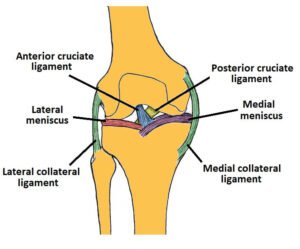
What is the function of PCL?
- Prevents the tibia from sliding too far backward under the femur,
- Helps maintain overall stability of the knee, particularly during activities that involve knee flexion and rotation.
- Works together with the anterior cruciate ligament (ACL) to control forward and backward motion of the knee.
How does PCL rupture or tear happen?
A PCL rupture or tear occurs when a powerful force is applied to the knee, especially when it is bent.
The common mechanisms are
- Direct blow to the front of a bent knee during car accidents
- Falling onto a bent knee
- Sports injuries: Collisions, tackles, or falls in sports like football, skiing, or gymnastics
- Extreme bending (hyperflexion) or straightening (hyperextension) of the knee can overstretch and rupture the ligament.
What are the symptoms of PCL injury?
- Pain: Usually felt at the back of the knee, and can develop immediately or within hours after injury.
- Swelling: Develops due to bleeding around the ligament, leading to stiffness and limited movement.
- Stiffness: Difficulty to bend or straighten fully.
- Difficulty bearing weight
- Instability: The knee may feel unstable or as if it might “give out,” particularly when walking downhill, descending stairs, or changing direction quickly.
- Chronic symptoms: If untreated, chronic PCL injuries can cause ongoing discomfort, aching, or instability, particularly during activities like climbing stairs, squatting, or walking long distances.
What is the immediate management following knee injury?
The immediate management of knee injuries focuses on minimizing pain, swelling, and further damage. These include:
- Protection: Remove the person from play or activity to prevent further injury.
- Rest: Avoid activities that cause pain and offload the knee as much as possible. Crutches may be used if weight-bearing is painful.
- Ice: Apply an ice pack to the injured area for 15–20 minutes every 1–2 hours while awake, for the first 48–72 hours. Do not apply ice directly to the skin to avoid burns.
- Compression: Use an elastic bandage to wrap the knee, starting below and finishing above the joint. The bandage should be snug but not so tight that it restricts blood flow.
- Elevation: Keep the knee elevated as much as possible, especially in the first 24–48 hours, to reduce swelling.
- Medical Care: Visit your nearest medical services for further evaluation and management.
What are the investigations needed?
- X-rays: May help rule out fractures or assess for posterior tibial subluxation, but are not definitive for ligament injury.
- MRI: The gold standard for confirming PCL tears and evaluating associated injuries to other knee structures
What are the treatment options for PCL tears?
Treatment options for PCL tears depend on the severity of the injury, associated injuries, and patient activity level.
Non-surgical treatment:
- Physical Therapy & Rehabilitation: Focuses on strengthening the quadriceps and other muscles around the knee, improving mobility, and restoring function.
- Lifestyle Modifications: Avoiding high-impact activities
Surgical Treatment:
Surgery is generally reserved for severe (grade III) PCL tears, combined ligament injuries (e.g., ACL and PCL), avulsion fractures, or when conservative management fails. The surgery involves reconstruction of PCL using a graft (patient’s own hamstring tendon). The procedure is done as a key-hole surgery (Arthroscopy). To know more about PCL reconstruction surgery, Click Here