
What is knee meniscus and its anatomy?
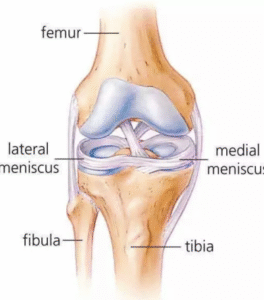
The meniscus is a crescent-shaped pad of fibrocartilaginous tissue within the knee joint. Each knee contains two menisci:
Medial meniscus: Located on the inner side of the knee.
Lateral meniscus: Located on the outer side of the knee.
What is the function of meniscus in knee?
- The menisci act as natural shock absorbers, cushioning the knee joint.
- Load Transmission and Distribution within the joint
- Contributes to the stability of the knee joint
- Increase the congruency between the joint surfaces, allowing smoother and more controlled movement within the joint.
- Lubrication and Nutrition of the joint cartilage
- Proprioception: contributes to balance and coordination.
How can we get meniscus tears or injuries?
- Twisting/Pivoting Movements in sports like tennis, basketball, and football.
- Deep Squatting or Kneeling activities either in sports or during certain occupations
- Heavy Lifting: Lifting heavy objects improperly with bent knees
- Direct Trauma to knee
What are the types of meniscus tears?
Based on the cause of tears it is classified as:
- Traumatic (Acute) Tears: Typically occur in younger, active individuals following a specific injury. These are other seen with other ligament injuries, such as ACL tears.
- Degenerative Tears: Seen more often in older adults or those with osteoarthritis. These develop over time as the meniscus tissue becomes less resilient with age or repeated stress.
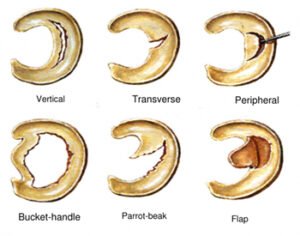
Based on the shape, location and orientation within the knee, meniscus tears can be classified as:
- Longitudinal Tear: Runs lengthwise along the C-shaped curve of the meniscus.
- Bucket-handle tear: It is a large longitudinal tear with ta flipped fragment into the joint
- Radial Tear: Cuts straight from the inner free edge toward the outer rim
- Horizontal Tear (or cleavage tear):
- Flap Tear: A piece of the meniscus becomes unattached, forming a “flap”
- Complex Tear: Involves a combination of the above tear patterns often seen with degenerative menisci in older adults.
- Root Tear: Involves the attachment (root) of the meniscus to the tibia bone. These can significantly compromise knee stability and function.
What are the symptoms of meniscus injury?
- Knee pain
- Swelling or stiffness
- Catching or locking of the knee
- Difficulty bending or straightening the knee
- Clicking, crunching, or tenderness
What are the investigations needed?
- X-rays: Meniscal tears are not visible on X-rays but can help exclude bone fractures or arthritis that may mimic meniscal symptoms.
- MRI (Magnetic Resonance Imaging): MRI is the gold standard for non-invasive confirmation of meniscal tears, showing location, type, and extent.
What are the treatment options for meniscus tears?
Treatment options for meniscal tears depend on factors such as the type, location, and severity of the tear, as well as patient age, activity level, and related conditions.
Non-Operative Treatment is often recommended for:
- Degenerative tears in older adults
- Tears with mild symptoms
- Tears that do not cause mechanical symptoms (locking, catching)
Non-operative management includes:
- Oral medications to reduce pain and inflammation.
- Physical therapy: Exercises to restore knee strength, stability, and mobility.
- Corticosteroid injections: To suppress inflammation in selected cases.
- Biologic injections (Plasma or PRP injections): to promote healing.
Surgical Treatment:
Surgery is considered a first choice for certain tear types like bucket handle or root tears or if non-operative treatments fails for other tear types.
Surgery includes
- Arthroscopic Partial Menisectomy
- Arthroscopic Meniscal Repair
To know more about the surgery, Click Here