
What is shoulder arthritis?
Arthritis is damage to the cartilage in joints. Shoulder arthritis occurs when the cartilage starts breaking down on the ball and/or socket sides of the shoulder joint.
When do I need a shoulder replacement?
Arthritis in the shoulder can cause pain and stiffness. If the symptoms in the shoulder has got to a point where non-operative measures are no longer controlling symptoms and function is deteriorating then a shoulder replacement will give you the best chance of having a pain-free functional shoulder.
What is total anatomical shoulder replacement?
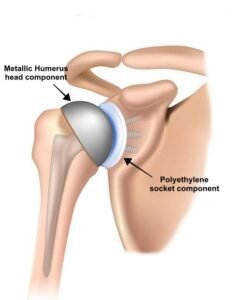
The aim of the operation is to replace the diseased joint surfaces with artificial prostheses. The top of the humerus (the ball part of the joint) is replaced with a strong alloy metal or hard. The Glenoid (the socket part of the joint) is replaced with a piece of durable, molded polyethylene. The operation will be done through a vertical incision over the front of the shoulder. The duration of surgery is 90 min.
What are the usual outcomes of the surgery?
You will have very good pain relief in a few days. Once fully recovered you should expect to a similar or slightly better range of movement than before surgery. If you look after the new shoulder the current evidence suggests it could last 10-15 years or more.
What are the potential complications?
- Infection
- Stiffness – usually resolves in 3 months with physiotherapy
- Fracture
- Dislocation
- Nerve injury – very rare and in most cases full recovery is seen in 6 months
- Loosening – late complication happening after a few years
- Tendon failure – late complication happening after a few years
What is the usual post-operative recovery period?
Length of hospital stay: Normally 2-3 days
Arm immobilisation: 4 weeks in sling or brace
Total recovery period: 3 months
Return to driving car: 6 to 8 weeks
Return to work: Desk based job 4 weeks, Manual job – 3-4 months